

The 15 Hank Aaron Cards Every Collector Should Know
Summary & Career Highlights
Rookie Year: 1954
Iconic Rookie Card: 1954 Topps #128
Highest Public Sale: 1954 Topps #128 PSA 9 for $720k with Fanatics Premier in August 2022
Similar Career Players: Willie Mays, Stan Musial, Ted Williams, Frank Robinson, Mickey Mantle, Barry Bonds, Babe Ruth
Players with Similar Cards to Check Out: Willie Mays, Mickey Mantle, Roberto Clemente, Ernie Banks, Frank Robinson
Career Highlights
755 career home runs — MLB all-time record at retirement
NL MVP (1957)
3x Gold Glove Award (1958, 1959, 1960)
25x All-Star selection (Highest of any player)
1957 World Series Champion with the Milwaukee Braves
NL batting title (1956, 1959)
2,297 career RBI (MLB all-time record)
Broke Babe Ruth's all-time home run record on April 8, 1974
1982 Baseball Hall of Fame inductee
Iconic Cards
Collecting Hank Aaron means following one of baseball's most complete careers through a card catalog that spans five decades and some fascinating stops along the way. It starts, as it should, with the 1954 Topps rookie, one of the most recognizable cards Topps has ever released. But that's not the only door into early Aaron. The 1954 Johnston Cookies offers a rarer regional alternative from the same year, while the 1955 Bowman gives Bowman-focused collectors their one and only Aaron option before the brand went dormant.
Aaron's playing-days catalog is dominated by Topps, and his 1950s run is as collected as any star from the era not named Mantle or Mays. There's the scarce yellow-name variation on his 1958 Topps card, the beloved Mantle pairing from that same year, and his appearances in the All-Star subset. The second half of Aaron's iconic card story is anchored by moments rather than sets. The 1974 Topps #1 marks the Ruth record, and his 1976 Topps cards close out his playing days.
Aaron's modern releases don't carry the same weight as his playing-days cards, but a few matter. His 1991 Upper Deck Heroes autograph stands as one of the earliest pack-issued signed cards in the hobby, while the 2000 Upper Deck 3,000 Hit Club triple relic and the 2003 Stadium Club dual autograph with Willie Mays represent the premium end of his certified catalog. Collecting Aaron is ultimately about honoring a career whose place in history is unambiguous, and his card catalog gives you plenty of meaningful ways to do it.
Icon Key
Estimated Cost:
💰 - Under $250
💰💰 - Under $1,000
💰💰💰 - Under $5,000
💰💰💰💰 - Under $15,000
💰💰💰💰💰 - Over $15,000
Rarity:
💎 - Common, High Serial Number
💎💎 - Serial Numbered or Less Than 200 in Population
💎💎💎 - Serial Numbered or Less Than 100 in Population
💎💎💎💎 - Serial Number or Less Than 50 in Population
💎💎💎💎💎 - Extremely Rare: Serial Numbered or Less Than 10 in Population
Please note that this site contains affiliate links, and The Smarter Collector may earn a commission if you make a purchase through these links. This comes at no additional cost to you and helps support the site so we can continue to provide valuable content. Thank you for your support!
1954 Johnston Cookies
#5


As an eBay Partner, I may be compensated if you make a purchase.
Prospective Card Cost: 💰💰💰💰
Rarity: 💎
About the Card: Hank Aaron has one true rookie card, his 1954 Topps. But there was another card released that same year that's just as desirable and orders of magnitude rarer. The 1954 Johnston Cookies set was a regionally distributed food issue with a checklist made entirely of Milwaukee Braves, including Eddie Mathews and Warren Spahn alongside Aaron. Around 500 copies have been graded across PSA and SGC combined, making this the early-career Aaron to chase if rarity matters more to you than chasing a higher grade.
1954 Topps
#128


As an eBay Partner, I may be compensated if you make a purchase.
Prospective Card Cost: 💰💰💰💰💰
Rarity: 💎
About the Card: Hank Aaron's 1954 Topps is one of the most recognizable cards from the early Topps era. Considered his only true rookie card, the bold orange background frames an illustrated portrait of a 20-year-old who would go on to become the all-time home run king. White borders run along the left, right, and bottom, while the orange extends to the very top edge and that's worth noting, because the orange top is prone to chipping, which makes higher-grade copies challenging to find.
1955 Bowman
#179


As an eBay Partner, I may be compensated if you make a purchase.
Prospective Card Cost: 💰💰💰
Rarity: 💎
About the Card: If you're a Bowman collector, this is your one and only Hank Aaron option. The television screen die-cut frame was unlike anything else from the era and marked a memorable send-off for Bowman's final year before its modern resurrection in 1989. The full-color image set inside the screen was a nod to the biggest innovation of the era: the color television. Aaron's 1955 Bowman is roughly twice as scarce as its 1955 Topps counterpart, though it trails well behind in popularity and demand. Still, it offers something different from the standard Topps run if you're looking to add something beyond his basic Topps run.
1955 Topps
#47


As an eBay Partner, I may be compensated if you make a purchase.
Prospective Card Cost: 💰💰💰
Rarity: 💎
About the Card: Arguably Aaron's second most important Topps card is also his second-year Topps card. Known as the home of the Roberto Clemente and Sandy Koufax rookie cards, 1955 Topps carries its longevity through star power despite lacking Mickey Mantle. The horizontal design built on the Topps' budding aesthetic: bold background colors, player illustrations, and facsimile autographs framed by the team logo and player/team/position badge. Poor centering plagued 1955 Topps, making well-centered copies hard to come by.
1956 Topps
#31 White Back


As an eBay Partner, I may be compensated if you make a purchase.
Prospective Card Cost: 💰💰💰
Rarity: 💎
About the Card: 1956 Topps continued building on the design of the 1955 set, keeping the horizontal orientation. Rather than floating player portraits on plain backgrounds, each card featured a full art action image behind the portrait, with a subtle white outline that made the player's portrait pop. It's one of the better designs of the '50s and remains hugely popular despite not having an iconic rookie to anchor the set. 1956 Topps was printed on both white and gray card stock, creating the "White Back" and "Gray Back" variations. Gray Backs are slightly rarer for cards numbered under #100, but the price differences are largely negligible.
1958 Hires Root Beer
#44 With Tab


As an eBay Partner, I may be compensated if you make a purchase.
Prospective Card Cost: 💰💰💰💰
Rarity: 💎💎
About the Card: 1958 Hires Root Beer was a 66-card set created to sell root beer. Each carton came with a card that had a panel advertisement attached, encouraging consumers to "Join the Hires Baseball Club Today!" When you search for the set today, you'll find "With Tab" and "Without Tab" versions, referring to whether that attached panel is still intact. Interestingly, the graded population for both versions is fairly similar, yet the With Tab version tends to run about 3–4x more expensive, as vintage collectors place a premium on original, unaltered condition.


1958 Topps
#418 Mickey Mantle & Hank Aaron World Series Batting Foes


As an eBay Partner, I may be compensated if you make a purchase.
Prospective Card Cost: 💰💰💰
Rarity: 💎
About the Card: The 1958 Topps World Series Batting Foes featuring Hank Aaron and Mickey Mantle is one of the most iconic multi-player cards of the 1950s. It commemorates the 1957 Braves/Yankees World Series, which the Braves won in seven games, and marks the first time Aaron and Mantle appeared on a card together. Low-grade copies can be found for a few hundred dollars, making this a relatively accessible way to land two of the decade's biggest names in one card.
1958 Topps
#30 Yellow Name


As an eBay Partner, I may be compensated if you make a purchase.
Prospective Card Cost: 💰💰💰💰
Rarity: 💎
About the Card: Hank Aaron's 1958 Topps #30 comes in two variations: the standard version with his name in white letters, and an error version with his name in yellow. The yellow letter error is significantly scarcer than the white letter version, and carries a meaningful premium as a result. A PSA 9 copy, pop 1 at the time of sale, brought an eye-poping $174k result through Love of the Game Auctions back in 2022.
1958 Topps
#488 All Star


As an eBay Partner, I may be compensated if you make a purchase.
Prospective Card Cost: 💰💰
Rarity: 💎
About the Card: All-Star cards are a staple of Topps flagship releases today, but that wasn't always the case. The All-Star subset made its debut in 1958 Topps and established a format that would carry forward for decades. By 1958, Aaron was heading into his fourth of a record 25 All-Star selections that year. National League All Stars were featured in front of a blue and white star background, while American League players appeared against red and white stars.
1959 Home Run Derby


As an eBay Partner, I may be compensated if you make a purchase.
Prospective Card Cost: 💰💰💰💰💰
Rarity: 💎💎💎
About the Card: Long before MLB's first official home run derby in 1985, ABC's Wide World of Sports hosted "Home Run Derby," a weekly series pitting two of the era's top sluggers against each other. The winner walked away with $2,000; the loser took home a $1,000 consolation prize. The show was popular enough to warrant its own 20-card set. The oversized black-and-white cards are exceedingly rare today with fewer than 100 of Aaron's copies ever having been graded.
1974 Topps
#1 All Time HR King


As an eBay Partner, I may be compensated if you make a purchase.
Prospective Card Cost: 💰
Rarity: 💎
About the Card: Hank Aaron broke Babe Ruth's all-time home run record on April 8, 1974, hitting his 715th career home run against the Los Angeles Dodgers. The timing was just right, early enough in the season for Topps to squeeze the "New All-Time Home Run King" card into the first spot of the year's set. It's not the rarest or most condition-sensitive card of Aaron's Topps run, but its nod to the moment has kept it popular with collectors ever since.
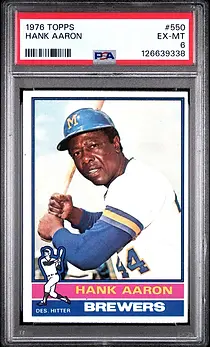
1976 Topps
#550

As an eBay Partner, I may be compensated if you make a purchase.
Prospective Card Cost: 💰💰
Rarity: 💎
About the Card: 1976 Topps was Aaron's final Topps card as an active player, marking the end of his storied career and it's the only card on this list to feature him as a Milwaukee Brewer. Aaron also appears as the first card in the 1976 set, part of the "Record Breakers" subset honoring his 1975 lifetime RBI record of 2,262. Both cards are comparatively affordable within his basic Topps run, so whichever one speaks to you is a fitting way to mark the end of Aaron's playing days.
1991 Upper Deck Heroes
#27 Hank Aaron Autograph Checklist


As an eBay Partner, I may be compensated if you make a purchase.
Prospective Card Cost: 💰💰💰
Rarity: 💎
About the Card: It might be hard to believe today, but pack-issued autograph cards were once considered gimmicks. In the early 1990s, competition among card manufacturers was intense, and companies were looking for ways to stand out. Upper Deck, which arrived on the scene in 1989, leaned into the pack-issued autograph as a way to differentiate their sets. The Baseball Heroes autograph series launched in 1990 with Reggie Jackson, followed by Nolan Ryan and Hank Aaron in 1991. Hand numbered to 2500 copies, it's one of the earliest pack-issued autographs in the hobby and remains a favorite with collectors today.
2000 Upper Deck
#HA-BS A Piece of History 3000 Hit Club Bat-Jersey-Autograph /44


As an eBay Partner, I may be compensated if you make a purchase.
Prospective Card Cost: 💰💰💰💰
Rarity: 💎💎💎💎
About the Card: I've covered Upper Deck's "A Piece of History 500 Home Run Club" extensively across other profiles on the site, but this is the first card I'm featuring from the 3,000 Hit Club version. Upper Deck inserted memorabilia cards of each player in the 3,000 Hit Club across products in 2000 and 2001. Most contained either a jersey swatch or a bat piece, but this parallel combines both, along with an on-card autograph, and is serial numbered to Aaron's jersey number, 44. For a post-playing days Aaron card, it's hard to ask for much more.
2003 Topps Stadium Club
#CS-AM Co-Signers Hank Aaron / Willie Mays Dual Autograph

As an eBay Partner, I may be compensated if you make a purchase.
Prospective Card Cost: 💰💰💰💰💰
Rarity: 💎💎💎💎
About the Card: Hank Aaron and Willie Mays were arguably the two greatest African-American baseball players of the 1950s and '60s, yet it took until 2003 for them to appear on a dual autograph card together. That debut came in 2003 Topps Stadium Club's Co-Signers set. The design holds up beautifully, it nods to the vintage era while feeling at home in a 2003 product. Aaron has a few on-card autographs on this list, but this one sits at the top.
A Few of My Favorites
Quirkiness is the theme underpinning the five favorites I've selected here. Each one lives outside Aaron's flagship Topps issues: oversized formats, stand-up displays, and a dry-cleaning promotion out of Milwaukee. The 1964 Topps Giants, the 1964 Topps Stand-Up, the 1967 Topps Stand-Up test issue, the 1969 Topps Super, and the Spic and Span all reward collectors who enjoy the odd corners of the hobby and were cards chosen for their stories and designs as much as the player they feature.
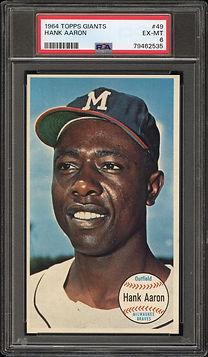
1964 Topps Giants
#49

As an eBay Partner, I may be compensated if you make a purchase.
Why It's a Favorite: The one-and-done 1964 Topps Giants set had one fatal flaw: collectors at the time didn't like non-standard card sizes. Which is a shame, because the design has stood the test of time. Clean, simple, built around some of the best player photography of the 1960s, with just a small baseball in the corner noting the player's position and team. The 60-card checklist is stacked with the era's biggest stars and makes for a fun set to build. It's one of my favorites, as long as you've sorted out a storage solution for the oversized format.
1964 Topps Stand-Up


As an eBay Partner, I may be compensated if you make a purchase.
Why It's a Favorite: 1964 Topps Stand-Up was an oddball release. One designed to decorate a shelf, not sit in a binder. Each card in the 77-card set features a player image set against an instantly recognizable yellow and green background, with a die-cut silhouette meant to be punched out and the background folded in half to create a stand-up display. Un-punched copies command a premium over their punched counterparts, but there's something I charming about the folded, punched-out versions that makes you wonder just how much a kid treasured it.
1967 Topps Stand-Up
#20


As an eBay Partner, I may be compensated if you make a purchase.
Why It's a Favorite: 1967 Topps Stand-Up was never broadly distributed. The copies you find in the market today are test issues and the only ones that ever made it into circulation. Apparently the floating head concept didn't resonate the way the 1964 Topps Stand-Up design did. Because of that limited release, the card is extraordinarily rare, with only a handful of sales ever publicly documented. You'd be lucky to get the chance to bid on this card, regardless of condition.
1969 Topps Super
#34


As an eBay Partner, I may be compensated if you make a purchase.
Why It's a Favorite: Topps never quite gave up on oversized cards. The 1964 Topps Giants made a memorable splash but couldn't justify a second year. Five years later, Topps tested the format again with a limited release to New York collectors, what we now know as 1969 Topps Super. The set was essentially a trial run to gauge interest ahead of a planned national release for 1970 Topps Super. That regional scope makes the 1969 issue scarcer than the mass-printed Topps sets of the era.
1954-56 Spic and Span Hank Aaron


As an eBay Partner, I may be compensated if you make a purchase.
Why It's a Favorite: You've heard about cards being used to promote tobacco, gum, chips, and even hot dogs. But what if I told you that one of the rarest Hank Aaron cards was actually a promotional card from a dry cleaning company? Spic and Span, a Milwaukee-area dry cleaner, released 18 index sized advertisements featuring the Braves' biggest stars. It's another quirky, niche, oversized card with a neat story that would look great in a unique Aaron collection.
Additional Resources
Hank Aaron Baseball Reference
A go-to source for Aaron's complete MLB stats, milestones, and award history. Helpful for tracking the on-field accomplishments that often drive card value.Card Ladder Player Index – Hank Aaron
Explore historical pricing trends, recent sales, and collector sentiment for Aaron's cards tracked on the Ladder. A great tool for understanding market performance across sets and grades.PSA Set Registry – Hank Aaron Basic Set
Get a curated list of Aaron's base cards recognized by PSA's Registry. It's a useful framework for collectors building a focused, registry-worthy PC.Trading Card Database (TCDB) – Hank Aaron
Searchable checklist of every Hank Aaron card, including base, parallels, inserts, and oddballs. Ideal for set collectors or anyone looking to complete a player run.
More Player Profiles
If you enjoyed this Player Profile, here are a few more worth exploring

Barry Bonds

Mickey Mantle
