

The 15 Ted Williams Cards Every Collector Should Know
Summary & Career Highlights
Rookie Year: 1939
Iconic Rookie Card: 1939 Play Ball #92
Highest Public Sale: 1939 Play Ball #92 for $480k with Heritage Auctions in August 2021
Similar Career Players: Jimmie Foxx, Lou Gehrig, Hank Greenberg, Ralph Kiner, Mel Ott, Stan Musial, Joe DiMaggio, Babe Ruth
Players with Similar Cards to Check Out: Joe DiMaggio, Mickey Mantle, Willie Mays, Duke Snider, Yogi Berra
Career Highlights
2x AL MVP (1946, 1949)
2x Triple Crown (1942, 1947)
6x AL batting champion
Last player to hit .400 in a season (.406 in 1941)
521 career home runs
17x All-Star
Missed nearly five full seasons serving in WWII and the Korean War
Highest Career OBP (.482)
Boston Red Sox Hall of Fame inductee and retired #9
Iconic Cards
Ted Williams, the Splendid Splinter and baseball's greatest pure hitter, was the sport's biggest star for nearly two decades. He reached the 500 home run club despite losing almost five prime seasons to military service. A career like that deserves cardboard to match, and manufacturers delivered.
His pre-war run was headlined by Play Ball, with the 1939 Play Ball rookie standing as one of the most recognized cards of the era. Jump ahead to the '50s and, while Williams was conspicuously absent from the landmark 1952 Topps and Bowman sets, collectors still had plenty to chase. From his first Topps cards in 1954 to his 1954 Bowman (A card that was never supposed to exist) his '50s issues remain some of the most sought-after in all of vintage. Williams also anchored food and promotional issues like the 1954 Wilson Franks and 1952 Red Man Tobacco, both collector favorites to this day.
He never had Mantle's national pull or Mays's five-tool game, but his hitting prowess and that legendary .406 season give him a collecting durability few vintage players can claim. Here are 15 of his most iconic cards, plus 5 of my own favorites.
Icon Key
Estimated Cost:
💰 - Under $250
💰💰 - Under $1,000
💰💰💰 - Under $5,000
💰💰💰💰 - Under $15,000
💰💰💰💰💰 - Over $15,000
Rarity:
💎 - Common, High Serial Number
💎💎 - Serial Numbered or Less Than 200 in Population
💎💎💎 - Serial Numbered or Less Than 100 in Population
💎💎💎💎 - Serial Number or Less Than 50 in Population
💎💎💎💎💎 - Extremely Rare: Serial Numbered or Less Than 10 in Population
Please note that this site contains affiliate links, and The Smarter Collector may earn a commission if you make a purchase through these links. This comes at no additional cost to you and helps support the site so we can continue to provide valuable content. Thank you for your support!
1939 Play Ball
#92


As an eBay Partner, I may be compensated if you make a purchase.
Prospective Card Cost: 💰💰💰💰💰
Rarity: 💎
About the Card: Ted Williams' 1939 Play Ball is his rookie card, and one of the most iconic pre-war baseball cards, though its status owes more to Williams himself than to the card. For its debut baseball set, Gum Inc. kept the design sparce: a black-and-white photo and a white border, with nothing on the front to identify the player — no name, no team. The set is also among the earliest to carry promotional "SAMPLE" cards: identical to the regular release, but overprinted in red advertising on the back. Those samples only run #1–115, which includes Williams at #92 — making his sample version dramatically rarer than the card collectors usually see.
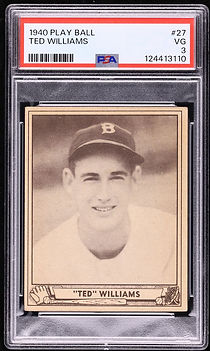
1940 Play Ball
#27

As an eBay Partner, I may be compensated if you make a purchase.
Prospective Card Cost: 💰💰💰💰
Rarity: 💎
About the Card: 1940 Play Ball refined the simple design of the 1939 release in a few notable ways. Gone was the hitting pose, replaced by a portrait photo of the then 22-year-old. The white border received an accent line, and "TED" was prominently featured in a nameplate at the bottom of the card. For collectors priced out of his 1939 Play Ball rookie, this sophomore release offers a more affordable early option with similar aesthetics.
1941 Play Ball
#14


As an eBay Partner, I may be compensated if you make a purchase.
Prospective Card Cost: 💰💰💰💰
Rarity: 💎
About the Card: The design of the 1941 Play Ball set borrowed a lot from the 1940 Play Ball set, including use of the same image and overall design. But there's no mistaking the two because 1941 Play Ball was released in full color, a first for Williams. Placed in front of a salmon/orange backdrop and accented by a purple shadow, the colors are loud and make a statement. While it's not mentioned anywhere on the card, Williams hit .406 in 1941, the last time any major leaguer accomplished the feat and is record unlikely to ever be broken.
1948 Leaf
#76


As an eBay Partner, I may be compensated if you make a purchase.
Prospective Card Cost: 💰💰💰💰
Rarity: 💎
About the Card: What do you get when you mix war propaganda poster aesthetics with fully saturated color? You get 1948 Leaf. The set has held up for good reason: it was Leaf's first issue, the first post-war color baseball card set, and it has a design unlike anything else from the era. It also doesn't hurt that the checklist is loaded with names like Babe Ruth and rookies of Jackie Robinson, Satchel Paige, Stan Musial, and Warren Spahn. Many players in the set got straightforward portrait images, which makes the action pose Williams is striking here all the more memorable.
1950 Bowman
#98


As an eBay Partner, I may be compensated if you make a purchase.
Prospective Card Cost: 💰💰💰
Rarity: 💎
About the Card: Gum Inc., the company behind Play Ball, halted card production after the United States entered WWII and wartime paper rationing took effect. When the war ended, Gum Inc. resumed releasing baseball cards, this time under the name of the company's founder, Jacob Warren Bowman. Bowman's 1948 and 1949 releases didn't include Williams, so 1950 marked his return to the brand. The card's full-color illustration depicts Williams in the batter's circle at Fenway Park, again without any identifying information, a nod to the design of his iconic 1939 Play Ball rookie.
1951 Bowman
#165


As an eBay Partner, I may be compensated if you make a purchase.
Prospective Card Cost: 💰💰💰
Rarity: 💎
About the Card: Look familiar? 1951 Bowman uses the same image as 1950 Bowman, with some slight alterations like clouds added to the sky in the background and a nameplate added to the bottom right of the card. While both 1950 and 1951 are similar in design, the 1951 set tends to be more popular given the additional design elements and the rookie cards of two players you might have heard of before: Mickey Mantle and Willie Mays. Low-grade copies are accessible, with prices typically in the low hundreds of dollars.


1952 Berk Ross


As an eBay Partner, I may be compensated if you make a purchase.
Prospective Card Cost: 💰💰💰
Rarity: 💎
About the Card: Having been recalled to serve in the Korean War, Williams missed essentially the entire 1952 season. That absence meant he wasn't included in either the landmark 1952 Topps or Bowman sets, leaving collectors looking for a 1952 Teddy Ballgame with limited options. One of those options is the 1952 Berk Ross, a colorful mid-career issue and part of a 72-card unlicensed set. Berk Ross, the set's creator, was rumored to be a Bowman photographer who repurposed images from previous Bowman releases to produce the set. It doesn't match the quality of its Topps and Bowman contemporaries, but it more than makes up for that in its obscurity which makes it a natural fit for the oddball collector.
1954 Bowman
#66


As an eBay Partner, I may be compensated if you make a purchase.
Prospective Card Cost: 💰💰💰
Rarity: 💎
About the Card: 1954 was full of corporate drama between Bowman and Topps for Williams' exclusive trading card rights. Bowman, confident they'd win him over, began printing his card in the 1954 set. The only problem: they lost out to Topps. Bowman had to scrap the full-color photograph card and replace Williams in the set entirely. Still, many copies made their way into circulation, and they've become some of the most sought-after short prints in the hobby because of the fascinating story behind the card.
1954 Topps
#1


As an eBay Partner, I may be compensated if you make a purchase.
Prospective Card Cost: 💰💰💰
Rarity: 💎
About the Card: We'll never know what we missed by not having a Ted Williams card in the 1952 or 1953 set. What we do know is that Topps wanted to make the most of their newly acquired exclusive trading card license for Williams. They did so by giving collectors two cards to chase in the 1954 checklist. Williams anchored both ends of the set, appearing at #1 and #250 in the 250-card checklist. There are roughly twice as many graded copies of his #1 compared to his #250.
1954 Topps
#250


As an eBay Partner, I may be compensated if you make a purchase.
Prospective Card Cost: 💰💰💰
Rarity: 💎
About the Card: Both of Williams' 1954 Topps cards, #1 and #250, share the same design elements: a portrait image, an action cutout, a facsimile autograph, and the team/player nameplate. Slight variations on each element give the two cards a distinctly different feel despite the shared template. #250's yellow background and close-up portrait have made it a collector favorite with its sales volume keeps pace with #1 despite having roughly half the graded population. The card was also selected as one of the 20 iconic Topps cards reimagined for Topps Project 2020, the Covid-era set that paired those subjects with 20 different artists.
1954 Wilson Franks


As an eBay Partner, I may be compensated if you make a purchase.
Prospective Card Cost: 💰💰💰💰💰
Rarity: 💎
About the Card: The mid 1950's were full of regional food issue cards. 1953 Mother's Cookies, 1954 Dan Dee Potato Chips, 1958 Hires Root Beer. But one of the rarest and most coveted food issue sets was the 1954 Wilson Franks. Customers received one card from the 20-card set in each package of Wilson Franks hot dogs they purchased. The card pictures Williams finishing a swing, with a package of Wilson Franks floating above his shoulder. For collectors focused on Williams' 1950s cards, this one is among the hardest to track down.
1955 Topps
#2


As an eBay Partner, I may be compensated if you make a purchase.
Prospective Card Cost: 💰💰💰
Rarity: 💎
About the Card: If it ain't broke, don't fix it and Topps seemed to take that to heart with Williams' 1955 card. The similarities to his 1954 #250 are hard to miss: same illustrated portrait, yellow background swapped for a yellow-white gradient, and a shift from vertical to horizontal orientation. Small changes, but the 1955 image feels a bit more accessible than either of his 1954 cards while holding onto the same aesthetic.
1967 Venezuela Topps
#148


As an eBay Partner, I may be compensated if you make a purchase.
Prospective Card Cost: 💰💰💰
Rarity: 💎💎💎
About the Card: If you're hunting for rare Ted Williams cards, his 1967 Venezuela Topps deserves a serious look. The 338-card set was printed in Spanish for the Latin American market. While it followed the design of its 1967 American counterpart, the configuration differed, notably including 150 retired legends, marked here with "RETIRADO" prominently across the center of the card. Graded population numbers are remarkably thin, barely cracking 100 total. It's an obscure issue, but a compelling one for collectors who prioritize rarity.
1992 Upper Deck Heroes
#36 Autograph /2500


As an eBay Partner, I may be compensated if you make a purchase.
Prospective Card Cost: 💰💰💰
Rarity: 💎
About the Card: It might be hard to believe today, but pack-issued autograph cards were once considered gimmicks. In the early 1990s, competition among card manufacturers was intense, and companies were looking for ways to stand out. Upper Deck, which arrived on the scene in 1989, leaned into the pack-issued autograph as a way to differentiate their sets. The Baseball Heroes autograph series launched in 1990 with Reggie Jackson, followed by Nolan Ryan and Hank Aaron in 1991, before arriving at Williams in 1992. Hand-numbered to 2,500 copies, it's one of the earliest pack-issued autographs in the hobby and remains a favorite with collectors today.
1939-1946 Salutation Exhibits


As an eBay Partner, I may be compensated if you make a purchase.
Prospective Card Cost: 💰💰💰
Rarity: 💎
About the Card: Postcard-sized cards were fairly common in the pre-war era, and the 1939–1946 Salutations Exhibits rank among Williams' earliest. Also known as W462, the identification number assigned by card historian Jefferson Burdick, the set was released over more than a decade. The black-and-white photograph is reproduced in brownish-red ink on a blank-backed card. It's significantly cheaper than his 1939 Play Ball rookie, making it a solid option for collectors who can live with the oversized dimensions and want an early Williams card without the Play Ball price tag.
A Few of My Favorites
Beautiful cards, fun cards, unique cards, and cards that capture history. Not all cards need to be the most important or most iconic to be special and these five are great examples of that.
1952 Red Man Tobacco
#23


As an eBay Partner, I may be compensated if you make a purchase.
Why It's a Favorite: Arguably the most beautiful of all Ted Williams cards came in a tobacco product. Go figure. Each pouch of Red Man Tobacco included one 3½" x 4" oversized card from a 52-card set. Known for their stunning portrait illustrations and high-contrast backgrounds, these cards look more like works of art than trading cards. Each card had a removable tab at the bottom identifying its number in the set. Copies with the tab intact are rarer and more desirable than their no-tab counterparts.
1955 Topps Double Headers
#69/70


As an eBay Partner, I may be compensated if you make a purchase.
Why It's a Favorite: 1955 Topps Double Headers is a fun set, and one that was never meant to end up in a plastic slab. Unfolded, the front shows a full illustration of Ted mid-swing. Flip it over and you get the top half of a Hal Smith card, along with stats for both players. Fold it along the perforation and the card transforms into Hal Smith fielding a ball. That gimmick is exactly why unperforated, unfolded copies are so rare, and coveted by collectors.
1956 Topps
#5 White Back


As an eBay Partner, I may be compensated if you make a purchase.
Why It's a Favorite: 1956 Topps is my favorite of Williams' Topps cards. The diamond background with the white outline portrait just makes the card more interesting. These cards were also printed on both white and gray card stock, creating the "White Back" and "Gray Back" variations. Hobby publications and blogs cite white backs as the scarcer of the two, but grading population data tells a different story, gray backs actually outnumber white backs by nearly two to one. I'm honestly not sure what to make of that discrepancy. What I can say is that white backs are the sharper looking of the two.
1999 Upper Deck Retro
#521HR A Piece of History 500 HR Club


As an eBay Partner, I may be compensated if you make a purchase.
Why It's a Favorite: One of Upper Deck's responses to the late '90s/early 2000s memorabilia arms race was the "A Piece of History 500 HR Club" set. Building on the momentum of game-used cards, Upper Deck created an insert distributed across multiple products, featuring bat pieces from every member of the 500 HR Club, except Bonds and A-Rod. Approximately 350 copies exist, with nine autographed versions, a nod to Williams' jersey number. None of those autographed copies have surfaced publicly, so hit chasers ripping vintage 1999 Upper Deck Retro still hold out hope of finding some. The concept remains one of the more ambitious the hobby has seen.
2003 Upper Deck Ultimate Collection
#DW Dual Jerseys Gold Joe DiMaggio / Ted Williams /25


As an eBay Partner, I may be compensated if you make a purchase.
Why It's a Favorite: 2003 Ultimate Collection contained some of the nicest relics ever produced. The Dual Jersey relics, pairing game-used material from active stars and all-time legends, were some of my favorites. At the top of that checklist sits the Williams and DiMaggio pairing. The two rivals are inextricably linked: DiMaggio won the 1941 MVP on the strength of his 56-game hitting streak, even as Williams hit .406 that same season. It felt right to include at least one card that acknowledges that connection.
Honorable Mentions
Additional Resources
Ted Williams Baseball Reference
A go-to source for Williams' complete MLB stats, milestones, and award history. Helpful for tracking the on-field accomplishments that often drive card value.Card Ladder Player Index – Ted Williams
Explore historical pricing trends, recent sales, and collector sentiment for Williams' cards tracked on the Ladder. A great tool for understanding market performance across sets and grades.PSA Set Registry – Ted Williams Basic Set
Get a curated list of Williams' base cards recognized by PSA's Registry. It's a useful framework for collectors building a focused, registry-worthy PC.Trading Card Database (TCDB) – Ted Williams
Searchable checklist of every Ted Williams card, including base, parallels, inserts, and oddballs. Ideal for set collectors or anyone looking to complete a player run.
More Player Profiles
If you enjoyed this Player Profile, here are a few more worth exploring

Babe Ruth

Mickey Mantle
